
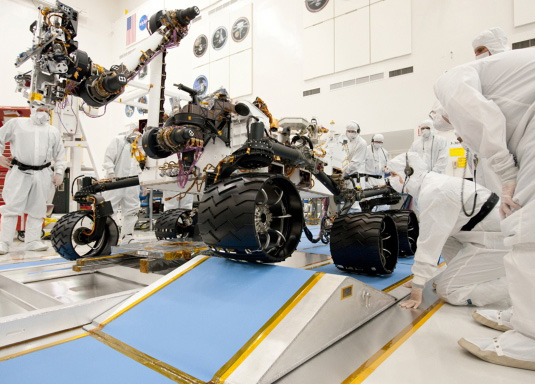

The Mars Rover “Curiosity,” launched in November of 2011, landed on Aug. 6, 2012, at Gale Crater on the surface of Mars to perform a variety of tests. According to NASA, one of the primary reasons “Curiosity” was launched is to test Mars for the ability to be habitable by humans.
As posted on NASA’s website, “Curiosity” is looking to determine the nature and inventory of organic carbon compounds, inventory the chemical building blocks of life (carbon, hydrogen, nitrogen, oxygen, phosphorous, and sulfur), and identify features that may represent the effects of biological processes.
The information collected will allow NASA to know if Mars has or has ever had the materials needed for life to exist. “Curiosity” is able to collect data by firing a laser at various rock samples and detecting the gases that are released. It then measures the amount and type of samples found.
NASA states that it is also looking to “characterize the broad spectrum of surface radiation, including galactic cosmic radiation, solar proton events, and secondary neutrons.” By doing so, NASA hopes to detect what type of radiation Mars receives at the surface of the planet to know what to predict for any future manned missions. It also measured radiation levels along the trip to Mars to see what astronauts would have to face on the way there.
NASA also hopes to find out what the water is like on Mars or if there is even an adequate amount. They are also trying to learn how the surface of the planet came to be shaped the way it is now.
Michael Christina, a member of the St. Paul’s School Robotics Club, gives his opinion on the importance of the “Curiosity” mission.
“I think the Mars Rover shows great advancement in robot technology. I hope to see the Mars Rover possibly find any forms of life, even if they are one-celled,” said Christina.
(Photo by Dutch Slager, NASA.)
 The Paper Wolf