

The year 2023 has brimmed with scientific revelations that have left the world in awe.
From groundbreaking advancements in genetics to the captivating mysteries of space, 2023 stands as a testament to the unquenchable thirst for knowledge that drives our species forward.
This feature will reveal and analyze some of the scientific achievements that pushed the boundaries of what we understand.
Space: The Final Frontier
Astronomers have discovered potentially habitable planets in distant star systems, but the immense distances pose a formidable challenge for interstellar travel. For example, Proxima Centauri B, the closest candidate, is 4.24 light years away, meaning it would take four years at light speed to reach it with advanced technology, which we don’t yet possess according to NASA.

To address this, scientists explore traversable wormholes, which warp space to shorten the distance between two points, essentially creating a shortcut through space, per Space.com.
Achieving this has been a long term goal, and quantum physicist Hatim Salih from the University of Bristol’s Quantum Engineering Technology Labs has proposed a plan using current technology and components, with hopes of executing the plan within the next three to four years.
This would result in mankind reaching far away worlds in which we could harvest resources, establish new cities, and maybe find new forms of life. This would be a huge leap in the development of mankind and would sprout the beginnings of what could lead us to rule over the stars.
This plan for space travel is far different than others. At first scientists would make up for the time it takes us to get to a destination by putting us in kryo sleep (freezing us) and waking us up when we get to the destination. With Salih’s plan, we could get there instantly.
In addition, another space invention includes the The James Webb Telescope, which was released on December 25, 2021 and has been shaking the foundations of what many modern day Scientists and astronomers believe.
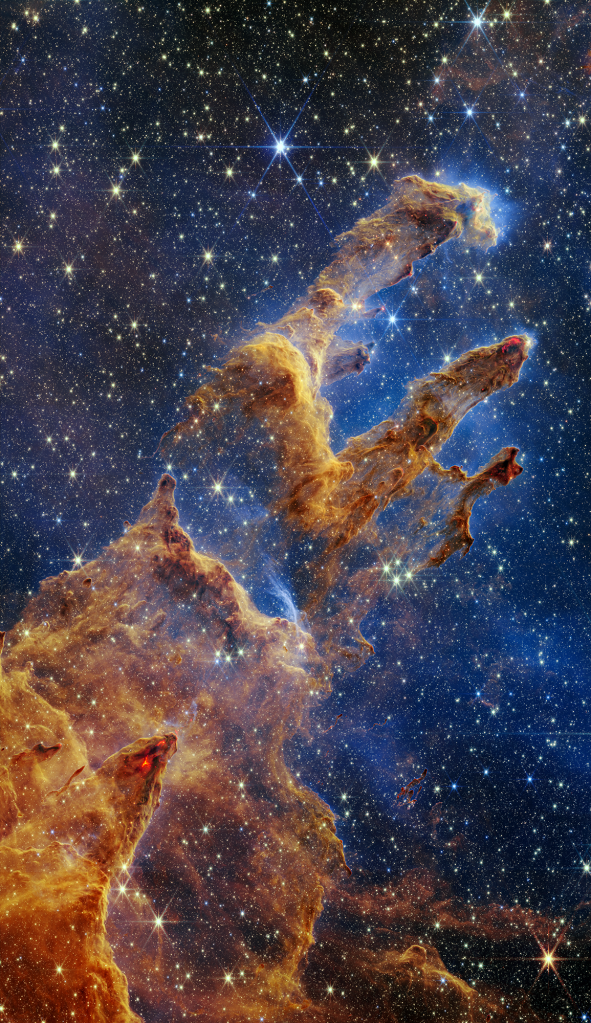
According to WebbTelescope.com, Webb has taken many photographs using complex systems, with its Near-Infrared Camera (NIRCam) that captures shorter wavelengths of infrared light and its Mid-Infrared Instrument (MIRI) that captures longer wavelengths of infrared light.
Light travels at a certain speed, meaning that some of those stars we stare at may already be gone. Meaning the farther Webb looks, the farther into the past the telescope looks.
In fact, Webb looked so far back, scientists got a look at what the universe looked like 500 to 700 millions years after its creation, says Alex Hughes from BBC ScienceFocus.com.
Many scientists expected to see new stars and galaxies forming, but what they saw shook the world of science.
They saw galaxies just as mature and as large as our Milky Way. Most galaxies take billions of years to form so the very existence of these galaxies posed a question: is the “Big Bang Theory” plausible anymore?
With all of these space discoveries spanning from planets made of diamonds to black holes that could dwarf our solar system, we have seen only a little of what the universe has to offer, but from what we have seen, the most rare thing in the entire universe is life. So we should be thankful that we were put here as a spectacle in the vast universe.
Cloning Debate: When Does Cloning Cross the Ethical Line?
Cloning is a heavily debated topic among the science community, with one half seeing the good that can come from cloning and the other half seeing the havoc that cloning could cause.
When cloning scientists looked to Cas9, it was adapted from a naturally occurring genome editing system that bacteria use as an immune defense. It can split DNA and combine it with other DNA. While many other factors are involved with cloning, scientists now know how to clone.
There are many upsides to gene editing and cloning.

- 22% of the world’s population is said to be against eating meat. Most reasons involve the mistreatment of animals. Cloning could get vegans back to eating meat. Instead of slaughtering animals for their delicious meat, we could clone different cuts of the meat. Therefore, there will be no more killing, and everyone can share joy in eating a nice steak.
- In rare cases, someone could be born with a disorder. Whether someone is born with one less limb or a weaker heart, cloning could solve your problems. You could clone yourself with a new heart or arm. If you have a problem with your body, cloning could solve it.
- Many animals are on the brink of extinction, like the Javan Rhinos or Mountain Gorillas. Scientists could save these animals from extinction. Believe it or not, this is not only for living animals. With cloning, we could be looking at another Jurassic Park.
- With gene editing, technology sickness could be forever put to rest.
Cloning and gene editing presents opportunities for cultural, technological, and societal advancement, but it also carries inherent risks.
Problems gene editing and cloning can produce

- Think about the following questions that cloning creates if a human being is cloned. Do they have a soul? What if the persons memories are shared? They are the same person, so who gets rights to their life?
- While editing DNA could stop sickness, it could also change a child’s potential height, eye color, hair color, and even the way they may act in the future. This could make a “perfect” human. One that could be faster, stronger, and smarter than your average person. This could set up specific career paths that the edited person will follow for the rest of their life, but is it our job to dictate the future of another human life.
- Other problems with cloning is that clones could be used for slave labor, war, or something worse.
Cloning and gene editing is a very new thing with many animals already being cloned and research being conducted to see if they can stop Alzheimers or cancer. There is a lot of good that can be done with this new technology, but there are some clear problems as well. The question is where should we draw the line.
Venture Into the Past
In a discovery that took scientists by surprise, an ancient skull dating back to 300,000 years ago has been found in eastern China. This skull, which is only the lower jawbone, doesn’t fit in with any other human fossils we’ve seen before.
A group of researchers from China, Spain, and the UK stumbled upon this unique find in 2015, alongside 15 other specimens from the same time period. This discovery could potentially change the way we understand our ancient human family tree.

The discovery of the 300,000-year-old skull in eastern China challenges our understanding of human evolution. Homo sapiens, thought to have emerged around 200,000 years ago in Africa, had advanced behaviors like burial practices and settled communities. The presence of new evidence among these older humans shows an earlier development of these behaviors. This shows why we should look deeper into the past. This discovery serves as a reminder that science can challenge established theories and reshape our view of human history.
Technology of the Future (or now)
With new innovations that are transforming our daily lives and enhancing national security, we wonder if all the future technology we see in movies is actually achievable.
In Huntsville, Alabama, the U.S. Army’s Directed Energy Systems Integration Laboratory (DESIL) is at the forefront of laser weapon technology.

The U.S. Army has opened a new lab called the Directed Energy Systems Integration Laboratory (DESIL) in Huntsville, Alabama, aimed at advancing laser weapon technology.
This lab, equipped with testing and simulation capabilities, will help the Army develop and integrate directed-energy capabilities more efficiently. It includes an outdoor test range with a laser energy-absorbing mound for testing purposes.
The Army plans to equip combat vehicles with lasers for air defense and is developing laser systems to counter various threats, including drones and missiles. DESIL will play a crucial role in evaluating and improving these laser systems for potential battlefield use.
Artificial Intelligence Boom

Artificial intelligence (AI) is changing the way we live and work, making many aspects of life more convenient. It helps us with things like finding information quickly online, organizing our schedules, and even writing long essays in the matter of seconds. AI-powered devices and applications make tasks easier and more efficient.
However, some people worry that AI might also encourage laziness. When AI takes care of tasks that used to require effort, it can lead to reduced physical activity and reliance on technology for everyday decisions. So, while AI has many benefits in simplifying our lives, it’s essential to strike a balance and use it wisely to avoid becoming overly dependent on it.
The future is now, with laser weapons and smart AI making life easier and safer. In Huntsville, Alabama, they’re working hard on lasers to protect us from drones and stuff, and AI is helping us do things faster and better. But people must be careful not to get too lazy, and remember to use the new technology wisely as we step into further into future.
 The Paper Wolf