

The United States’s stranglehold on dominance in the sport of basketball is slipping, as different countries worldwide are rapidly catching up.
The United States national team won the gold medal in the 2024 Paris Olympics; however, considering the team’s collection of talent, it was a pitiful performance. In fact, the heroics of the veterans, including Stephen Curry’s 36-point performance versus Serbia’s and the consistent greatness of 40-year-old LeBron James, were the only reasons they managed to bring home gold.
Heroics and legendary performances should not be necessary, though. They weren’t before; why are they now?
This underwhelming performance reflects a broader trend in the NBA and basketball. The USA is no longer the basketball tyrant it once was.
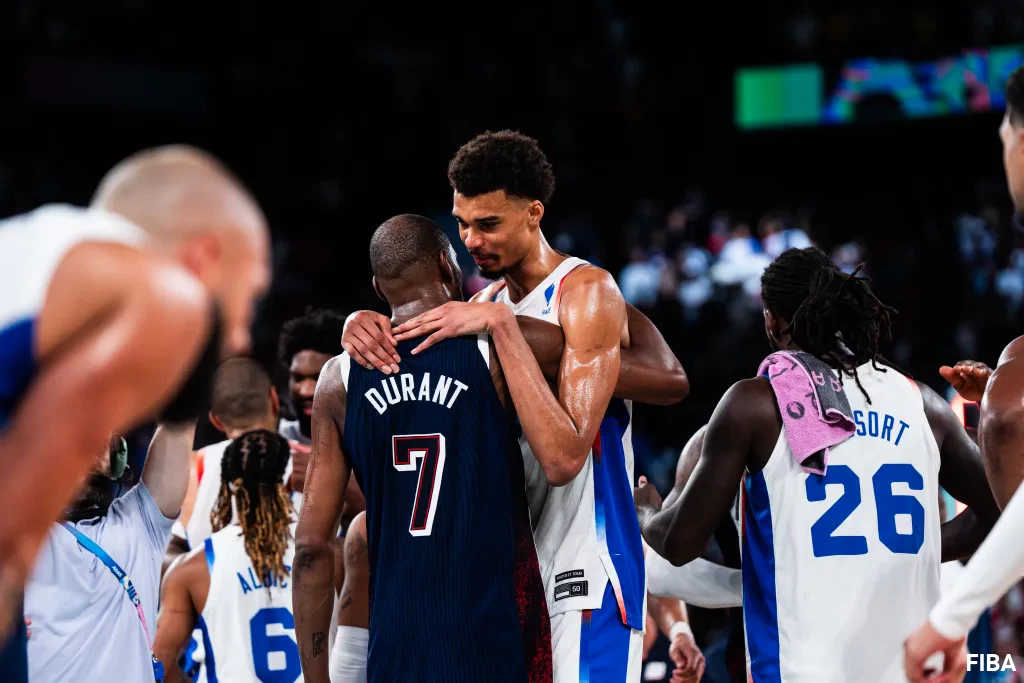
Jari Pestelacci / Eurasia Sports / Getty Images.
For instance, a record 21 foreign-born players were drafted in the 2024 NBA Draft. That’s 33% more than just four years ago. Not only is the volume of international players coming into the league at an all-time high, but the skill level of those players is as well. For example, last year’s consensus Rookie of the Year (ROTY) was the 7’4 Frenchman sensation Victor Wembanyama.
Wembanyama was so good last season that he had four-time NBA Champion and two-time Olympic gold medalist Draymond Green, saying, “I’m happy I got the opportunity to play against him now because they’ll have to deal with him a lot later, and I won’t be in the league no more, so that’s good for me,” after the Golden State Warriors nailbiting victory over the San Antonio Spurs late last season.
Wembanyama was not only the consensus ROTY but also on the All-Defensive 1st Team and placed 2nd in Defensive Player of the Year (DPOY), only behind another French big man, Rudy Gobert.
Although foreign, defensive-minded centers are familiar to the NBA, they have never been as prolific as they are now. Seven of the last 12 DPOYs have been foreign-born big men. This trend is bound to continue with the arrival of the 2nd overall pick, 7’1 Alex Sarr, and the aforementioned Wembanyama, who many project to win numerous DPOY awards in what may be one of the most extraordinary careers of all time.
In addition to being some of the most valuable defensive players in the league, foreign players are just as good, if not better, offensive players. For instance, the last five Most Valuable Players (MVPs), traditionally offensive awards, have all been foreign-born athletes.
One of these MVPs, Nikola Jokić, is considered one of the best offensive players ever. Because Jokić grew up learning basketball in a more team-centric atmosphere, he, along with other European stars, has a unique but effective style of play. Jokić’s one-of-a-kind combination of elite playmaking, post-scoring, and giant seven-foot frame makes him unguardable. His ability to read the game and deliver pinpoint passes has redefined the role of big men in the NBA.

“Because of Jokić and other international stars’ recent success, many European countries like France, Serbia, and Spain are investing heavily in youth programs and specialized basketball academies,” according to Saint Paul’s Junior Luca Rodas.
“It seems like most of the league’s best players, the ones I enjoy watching and going to games to see play, are not from America,” said Rodas.
Additionally, basketball’s growth isn’t limited to developing players coming into the NBA but also other leagues. International leagues like the EuroLeague and Australia’s NBL are growing in talent and popularity. European clubs now offer excellent salaries, and the quality of play is rising, which means more top-tier players are choosing to play in domestic leagues or spend time there before coming to the NBA.
In fact, the 2024 NBA Draft’s first and second overall picks, Zaccharie Risacher and Alex Sarr, played in foreign leagues rather than the traditional college route.
These are some of the many reasons the United States is starting to see more competition in the Olympics to the point where it’s no longer considered a sure thing or “lock” that the United States will win gold.
As more foreign-born players and rising international leagues shape the sport’s future, the NBA is no longer the exclusively American stronghold it once was.
 The Paper Wolf