
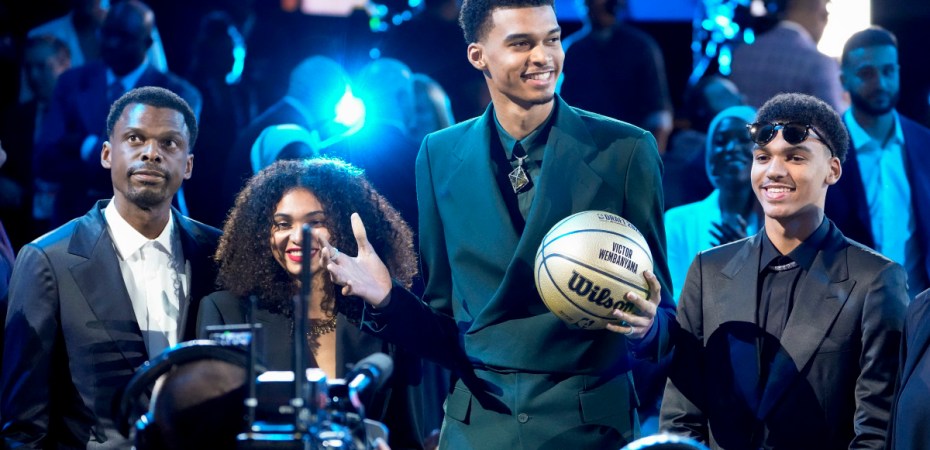
Filled with future superstars such as Victor Wembanyama, Brandon Miller, and Amen Thompson, and unexpected busts such as Scoot Henderson and Jett Howard, the 2023 class will go down as one of the most surprising and dominant classes of this era. Now, it’s time to look back at how teams would have drafted these players if they knew how they would have progressed.
1. San Antonio Spurs: Victor Wembanyama
Original pick: Victor Wembanyama
/origin-imgresizer.eurosport.com/2024/02/24/image-06b32385-4899-4529-bd39-d60b9deab92a-85-2560-1440.jpeg)
With the first pick in the draft, the Spurs made the easiest pick since LeBron James.
Coming into the draft, Wembanyama was the most hyped rookie prospect since James, and so far, he’s living up to the hype. The Pre-Draft hype surrounding Wembanyama arose due to him being a true anomaly, as we’ve never seen a player like him.
There were reasonable concerns that his body wouldn’t be able to withstand the physicality of the NBA; however, Wembanyama’s durability has yet to pose an issue, as he appeared in 71 games his first year. He only played 46 games last year; however, this was due to a rare case of deep vein thrombosis in his right shoulder, not a sign of weak durability.
One of Wembanyama’s main selling points was his unstoppable defense. At 7 feet 4 with an 8-foot wingspan, Wembanyama was shutting down All-Star players with his defense as a rookie and arguably would have won the Defensive Player of the Year (DPOY) award if his team had been more competitive. His wingspan makes it almost impossible to get a shot off against him, and in his first year, he led the league in blocks with 3.6 a game and soared to 3.9 in his sophomore season, a number the league hasn’t seen since 1998.
Offensively, Wembanyama is a beast, despite the fact that many scouts were critical of him coming into the draft. One anonymous scout said, “(Wembanyama is) absolutely awesome on defense, and not impactful at all on offense.” Another scout said, “There’s a reason he’s shooting so many (3-pointers), but it still feels like he’s giving the opposition a break every time he does it right now.”
However, ever since entering the league, Wembanyama has proved his critics wrong by averaging 21 points per game, shooting 47% from the floor, 33% from 3-point range, and 80% from the line in less than 30 minutes a game in just his rookie season. Even after his explosive rookie season, Wembanyama is still making leaps, with him increasing his points per game to 24.5 in just his second season.
Currently, Wembanyama is on pace to become one of the most exciting players in NBA history. This pick was obvious on draft night, and it’s still obvious now.
2. Charlotte Hornets: Amen Thompson
- Original pick: Brandon Miller

Initially criticized for his small size and nonexistent jump shot, Thompson made insane progress in his second season, becoming an athletic and defensive demon.
In his rookie season, Thompson was averaging just 9 points and 4 rebounds a game in 22 minutes, but in his second season, he elevated his game and increased his averages to 14 points and 8 rebounds a game. However, his growth didn’t stop there, with him going on an explosive run in January, averaging 18.7 points, 10.6 rebounds, and 4.3 assists over 12 games. This run showed his offensive potential and how he is still improving.
Thompson also proved he could flourish in the playoffs, averaging 15 points and 6 rebounds while assigned the task of slowing down the Warriors’ superstar point guard, Stephen Curry, for the series.
Despite taking a major leap offensively, Thompson is only hitting 23% of his three-pointers. If Thompson can develop an effective jump shot, he will be a future all-star.
Although he is making significant strides on the offensive end of the floor, Thompson’s strongest weapon is his defense, with him being able to lock up a team’s star guard or forward. In just his second season, Thompson had the 9th highest defensive rating, which earned him a place on the NBA All-Defensive First Team and 5th in DPOY voting.
In this reality, the Hornets would have gotten a defensive menace with offensive potential to pair with their franchise player, LaMelo Ball.
3. Portland Trail Blazers: Brandon Miller
- Original pick: Scoot Henderson

After receiving backlash from their fans on draft night, the Charlotte Hornets front office, notorious for drafting busts, seems to have finally found another star to pair with Ball.
Miller had an impressive rookie season, thriving in Ball’s absence. He averaged 17.3 points per game and shot 37.3% from 3-point range. His size and length also allowed him to be a menace on defense, making him one of the most valuable archetypes in basketball, a three-and-D wing.
What’s even more impressive has been Miller’s growth throughout his second season, jumping to 21 points per game and proving that he can thrive next to one of the biggest shot chuckers in the league.
However, some are concerned about Miller being injury-prone, due to the numerous injuries he’s already had, with Saint Paul’s senior Evan Vanderbrook saying, “There’s been multiple times where Miller was out for four-game stretches for random injuries, and he only played 27 games last year. I hope that it’s not gonna be a problem for him, but with the way LaMelo and Mark Williams’s careers have gone, I wouldn’t be surprised if it did.”
If the Trail Blazers had picked Miller, they would’ve got a player who averages over 20 points and is also one of the best three-and-D players in the league, instead of the inconsistent backup Point guard they got in Henderson.
Miller definitely has some concerns, but if he can improve his durability, he will surely develop into a star.
4. Houston Rockets: Gradey Dick
- Original pick: Amen Thompson

After what some would consider an okay rookie year, Gradey Dick has been on fire, becoming one of the most improved rookies in this class, with him jumping from 8 points per game to 14.4.
Dick has also improved his shooting and is slowly becoming one of the biggest three-point threats in this draft class. His three-point efficiency remains nearly as high as it was in his rookie season on more attempts, and he has evolved from his role of sitting in the corner and waiting for passes, and he has started to create more off-dribble shots for himself.
Dick has also grown more confident in attacking the rim, and he has begun to properly use his 6’8′ build to blow by defenders and get to the hole.
On the other end of the floor, Dick has finally become a somewhat competent defender, showing improvement in switching on screens and in isolation situations. Now that he isn’t just dead weight on defense, he has undoubtedly become one of the best players in this draft.
5. Detroit Pistons: Bilal Coulibaly
- Original pick: Ausar Thompson

Initially, the Pistons took Asuar Thompson with the 5th pick; however, ultimately, Bilal Coulibaly would have been a better pickup.
Thompson, like his brother, is a more defensive-minded player and prefers to pass rather than take risky shots. His defense heavily complements the Pistons and was a significant factor in the Pistons’ jump in wins last season. However, Coulibaly is also one of the better defenders in this draft, with him averaging 1.3 steals and 0.8 blocks per game, so if the Pistons had selected Coulibaly over Thompson, they wouldn’t be missing out on too much defensively.
Coulibaly also has the potential to be better offensively than Thompson, with him averaging 12.5 points per game compared to Thompson’s 8.4. On paper, this might not seem like a significant difference, but Coulibaly’s offense has at least improved from last season, jumping from 8.4 points to 12.5 points and doubling his assists, while Thompson has regressed, going from 8.8 points to 8.4 points per game.
6. Orlando Magic: Derrick Lively II
- Original pick: Anthony Black

On draft night, the Magic bet on Anthony Black, and while his efficiency has gotten worse, he could still have the potential to be the connective guard that the Magic need around Paolo Banchero and Franz Wagner. However, the Magic don’t have the best center situation, and you just can’t pass up on a guy like Derrick Lively II, who was putting up double-doubles against the Celtics in the 2024 NBA Finals as a rookie.
During the regular season, he averaged 9 points per game and 7.8 rebounds per game, and 7.9 points and 7.4 rebounds throughout his 21 playoff games.
Lively has proven himself to be one of the best shot blockers and rim protectors in this draft, averaging 1.7 blocks per game. With these skills, Lively would bolster the Magic’s already elite defense and could potentially be the final piece they would need in a playoff push. He may not have much potential to be a superstar center, but he definitely could have been a good building block for the Magic, who are a piece or two away from contending in the wide-open Eastern Conference.
7. Washington Wizards: Ausar Thompson
- Original pick: Bilal Coulibaly

Thompson has been locking down opponents while unlocking his potential with the Pistons. Thompson’s game is primarily built around his defensive skills, with his jump shot being his weak point, as evidenced by his shooting an egregious 21% on threes.
In his rookie year, Thompson played in 63 out of 82 games, while averaging 8.8 points and 6.4 rebounds. His defensive impact was immediately felt, with him averaging 1.1 steals per game, which increased to 1.6 this season.
However, he slightly regressed offensively last year, dropping to 8.4 points per game, and opted to take a backseat, focusing on defense.
The Wizards originally took Coulibaly with this pick; however, in this reality, he’s not on the board anymore, and with the Wizards having one of the lowest-rated defenses in the league, adding a defensive machine like Thompson would certainly improve the team’s standing.
8. Indiana Pacers: Cason Wallace
- Original pick: Jarace Walker

Cason Wallace has been one of the Oklahoma City Thunder’s best defenders this season, making him one of the bigger steals of this draft.
In his first season, Wallace played in all 82 games, while averaging 6.8 points, 2.3 rebounds, and 1.5 assists while shooting 49.1% from the field and an impressive 41.9% from three-point range. While his offensive efficiency was crazy, his perimeter defense was his greatest asset, averaging 0.9 steals per game.
Last season, Wallace slightly grew offensively, jumping to 7.3 points, 3.5 rebounds, and 2.4 assists per game, though his three-point efficiency has dropped to 33.3%.
Unlike his offense, his defense has seen massive improvement, nearly doubling his steals per game to 1.8.
While he’s been a strong fit for the Thunder, if the Pacers had selected Wallace, they might’ve had the defensive might to beat the Thunder in the Finals.
9. Utah Jazz: Keyonte George
- Original pick: Taylor Hendricks

Coming into the draft, Keyonte George was seen as a dynamic guard who could create his shots, and he’s lived up to his expectations and more.
As a rookie, George averaged 13 points, 2.8 rebounds, and 4.4 assists per game, shooting 39.8% from the field and 33.7% on threes, showing his potential to be a high-volume scorer. However, his efficiency has been inconsistent, which could be blamed on the fact that he was thrown into a high usage role, which he might not have been ready for in his rookie year.
Last season, George pumped up his averages, jumping to 16.8 points, 3.8 rebounds, and 5.6 assists. However, George’s efficiency is still nothing to write home about, and his defense also still needs some more time to develop, as he often struggles against bigger guards; nevertheless, his potential remains high.
Originally, the Jazz drafted Taylor Hendricks with the 9th pick and George with the 16th, but with Hendricks suffering a fractured fibula at the beginning of last season and George excelling at his high-scoring role. It would only make sense for the Jazz to draft George again.
10. Oklahoma Thunder: Scoot Henderson
- Original pick: Cason Wallace

Henderson entered the NBA with the expectation that he was gonna rival Wembanyama someday, but so far, he has failed to meet even a fraction of these expectations
Once seen as a player who would come in and immediately make the Trail Blazers better, Henderson has struggled to transition from the G-League to the NBA.
As a rookie, he averaged 14 points, 3.1 rebounds, and 5.4 assists per game, while turning the ball over 3.4 times a game. This gave him one of the worst assist-to-turnover ratios in the league.
On paper, 14 points per game might not look that bad, but the problem was his efficiency. In his rookie year, he shot a jaw-dropping 38.5% from the field and 29.9% on his threes, with him taking some ridiculous shots.
This has even caused some fans to make compilations of him airballing and bricking shots, with some videos reaching up to ten minutes long. Other fans, like Saint Paul’s senior Jonny McGinnis, have also been critical of his game, saying, “Scoot has been incredibly disappointing. He came in last year as the second-worst shooter in the league, and I don’t think he’s gonna get better soon. He’s a shot chucker who plays awful defense, kind of like a slightly better Julian Newman. On draft night, I thought he was gonna be better than Wemby, but clearly I was wrong.”
In his second season, Henderson has slightly improved on defense and has shown flashes of his potential, but he still hasn’t justified being a top-three pick, especially since he is now backing up Jrue Holiday. This disappointing turnout could be the result of the coaching situation in Portland, possibly making him a better fit on the Thunder, who could have developed him better, but he would need to truly break out to earn minutes on their star-studded roster.

The 2023 NBA Draft class has already seen many rises and falls. Stars like Wembanyama and Amen Thompson have solidified their status, while players such as Henderson have fallen from their high expectations. It’s only been two seasons since the draft, so in a few years, this redraft could look completely different.
Featured Image Photo Credit: Sports Illustrated
 The Paper Wolf