

The “Enhanced ACT” deceives students into believing they are taking an easier test, but the ACT’s changes are actively destroying academic futures.

According to its website, the ACT states that these changes are being implemented to benefit students and enhance the testing experience: “You’ll finish faster and feel less rushed thanks to the shortest test times yet… The Enhanced ACT is designed to reduce pressure, give you more control, and support your college goals — without sacrificing what colleges expect.”
Apparently, colleges don’t expect science scores, because the ACT has made the science section optional; the science section does not even count toward a student’s super-score.
This is one of the most controversial differences between the new “Enhanced ACT” and the old “Legacy Tests.”
While many people might think that this could only benefit students, especially those struggling with science, colleges will see through this mirage. Colleges will obviously be aware that a student who fails to submit his or her science score is attempting to inflate the numbers.
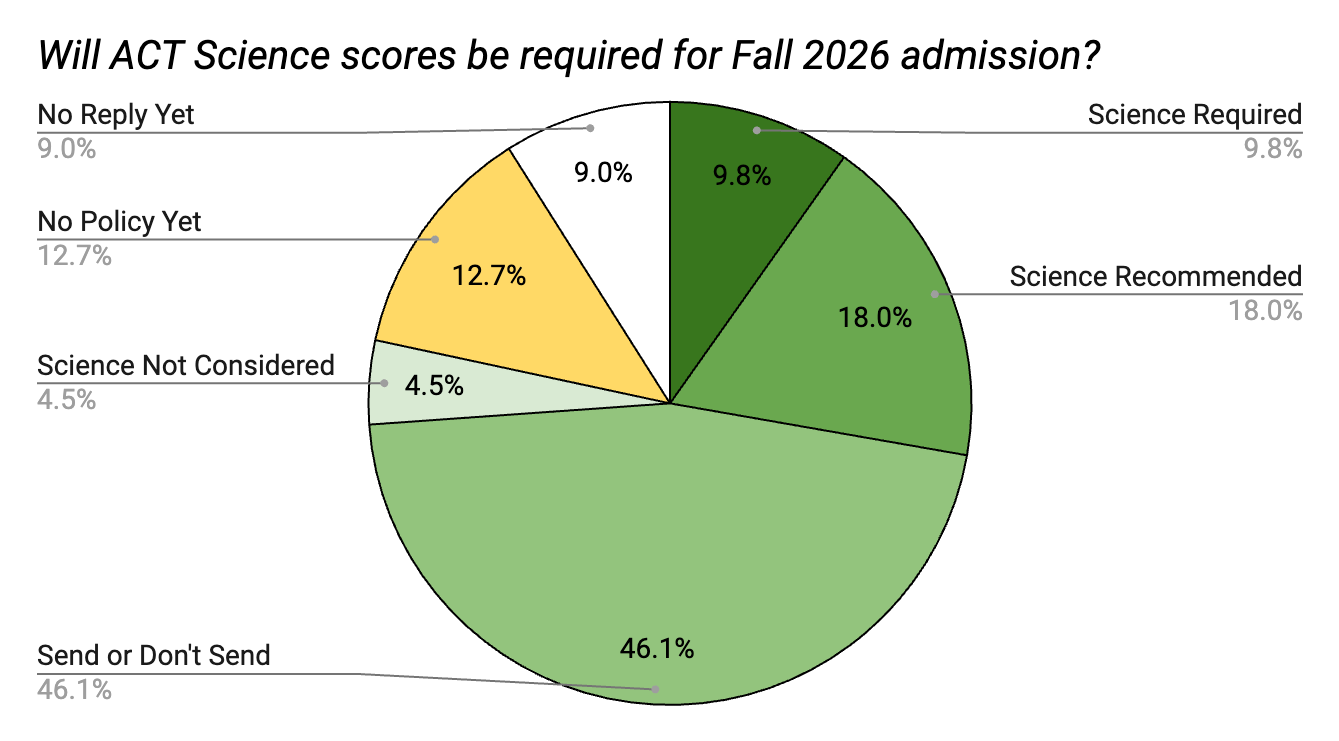
This will either cause colleges to start requiring students to take and submit a science test or make students without science portions less likely to be admitted. In other words, just because the ACT believes science is optional does not mean colleges agree.
Interestingly, even the ACT organization suggests trying the enhanced science test, despite it being optional, stating on its own website that students should take the science section because many colleges may require or prefer a science score.
It begs the question: Why make the section optional in the first place?
The ACT has not commented.
Predictably, science teachers across the country are infuriated by the change because it makes science as a whole look optional and insignificant.
Saint Paul’s physics teacher, David Arbo, is confused about these new changes. “One of the drawbacks involves the fact that science requires problem-solving and analysis. Students are just like adults; most of them will take the route that involves the least effort. Without a science score, colleges and students will miss an assessment that gives a good picture of critical thinking abilities.”
It’s easy to sympathize with science teachers, who are now grappling with the fact that a subject taught since elementary school is now deemed “optional.” As a result, students are questioning the credibility of their science curriculum as a whole. Moreover, from a teacher’s perspective, it was already challenging enough to motivate high school students to succeed in science.
Academia throughout America is up in arms about the omission of a required science section, but the ACT has yet to provide an explanation for the substantial shafting of science.
As if eliminating one-fourth of the entire test was not enough, the “Enhanced ACT” has also been shortened in other areas, but the shortening only serves as a shortcoming.
The ACT has always been a test that challenges test takers with a short amount of time to answer a large number of questions. The format of the Legacy Test challenged students to manage their test-taking time properly and helped build critical, yet quick-thinking skills. In other words, the ability of a student to perform well under the pressure of rigid timing was a significant factor that determined student success. Many believe this was a valuable skill that applies to other key aspects of life, including succeeding in most professional careers.
Essentially, the ACT is telling us that science as a subject and staying focused long enough to perform time-sensitive tasks are now obsolete.
For example, the legacy English section consisted of 45 minutes for 75 questions, and the enhanced English section is 35 minutes for 50 questions. The enhanced section provides an additional 6 seconds per question. Compared to the legacy test, this equates to about 5 more minutes of thinking time allowed, according to Saint Paul’s English I Honors teacher Nick Guarisco.
“A student’s pace, attention to detail, and ability to maintain focus throughout the entire test are all significant factors of the English section, as they should be. Rigid time constraints amplify the significance. However, there is some merit to the notion that those who are prepared and know the material well will be able to get through the test more efficiently,” stated Guarisco.
“An avenue is already available for students who need the extra time due to accommodations, so I’m not seeing the need for the change,” he added.

On the surface, this change benefits all students, but that logic is flawed because, ultimately, the ACT is a competition.
Not everyone wins, and not everyone should win.
For less gifted students, the extra time per question might be very beneficial, allowing them more time to think through their answers and therefore improve their scores; however, making the test easier from a timing perspective ultimately hurts stronger test-taking students because it allows others to close the gap.
The college application process is extremely competitive, but making this part of the game easier does not help, because allowing every team to start the game with 1-2 extra points is not actually a competitive advantage.
The math section is being shortened, with one option choice being eliminated from the previous five options for every question.
While the newest “improvement” of eliminating an answer option might sound like something to benefit students, it’s hurting them in ways they can’t see.
This is because with fewer options to choose from, there are fewer questions to work out and think about, which allows test takers to have a higher percentage of guessing a random answer and being correct. In other words, the change to fewer options increases the chances of students lucking into the correct answer.
The shortened test eliminates much of the diagnostic skill required for the test. As a result, many students do not have to work as hard or study and can rely more heavily on taking educated guesses, which further undermines the test’s credibility.
Saint Paul’s trigonometry teacher Gabe Emerson thinks the increased opportunities for guesses on the math section will damage the effectiveness of the ACT.
“Reducing the number of questions from 60 to 45 while increasing difficulty puts more pressure on students in less time. Fewer answer choices might seem helpful, but it can also raise the chances of guessing correctly, which doesn’t always reflect true understanding. Overall, these changes seem to benefit the test makers more than the test takers,” stated Emerson.
Another reason the math section was considered a disaster by many students was that the material tested was unfamiliar and unexpected. Several students who took the September test at Saint Paul’s complained about being tested on material they had never even seen on an ACT before. According to nearly every student who was polled after taking the Enhanced Test, the math section became harder, with many of the easier questions reportedly being replaced with more challenging topics.
According to Piqosity, the number of pre-high school integral thinking skills questions was decreased by 23%. At the same time, the number of function, algebra, and geometry questions has been increased anywhere from 2-5%. Yet, the ACT did not reveal that the math section would be modified, aside from fewer answer choices.
Students were unpleasantly surprised.
As a result, many Saint Paul’s seniors are terrified to receive their math scores and think the change in difficulty is unfair. Senior Avery Estrade is one of the many seniors that has an issue with the changes. “As I have been preparing for college apps, I have been putting tons of work into trying to increase my ACT math score… But I was surprised when the September test ended up being the hardest math test I took. I saw stuff [on the Enhanced ACT math section] that I had not reviewed in years of ACT prep,” stated Estrade.
The reading section is also easier. The Enhanced ACT changed it from 40 questions in 35 minutes to 36 questions in 40 minutes. This gives students about 14 extra seconds per question. In addition, the new format features shorter reading passages and fewer questions per passage, resulting in a “significantly less stressful and more accessible testing experience for students.”
Just because this generation of students struggles to focus long enough to read a passage does not mean the ACT should coddle them. Again, what kind of message is that sending?
All of these issues add up to the most significant underlying problem of the Enhanced ACT: inflated scores.
Due to the numerous changes to the ACT intended to benefit students, many individuals who previously struggled with the test will receive a significant boost, potentially increasing their scores.
With a decreased number of answers, each question will be weighted more heavily. This means that even one extra question right on the shorter test could bring a score up by 2 points. As stated, with the new science section being optional, the subject will not be counted in a student’s super-score (a composite score calculated by combining a student’s highest scores). As a result, many students will simply skip it to increase their score.
With a surge of higher ACT scores, students will face even more academic hurdles and competition when applying for colleges.
Saint Paul’s senior Andrew Dunne is concerned with many of the changes on the new test and how they can affect his future.
“Right now, I have a 36 on the science section, but with that section becoming optional, I am somewhat scared schools won’t value my score as much as they would have. Not to mention, will more and more people be scoring in the 30s? I hope my hard work does not blend in with a bunch of people who only did well on the new test,” stated Dunne.
While the new test is still in its infancy, most of the changes on the “Enhanced ACT” seem unnecessary, unexplained, and ultimately harmful for many students.
 The Paper Wolf