
Students are using AI to save time on assignments and homework, and it’s only increasing in popularity. While this does make life easier in the short term, the long-term effects on young minds could be detrimental.
On one hand, GPT is an incredible advancement in education. Many students use it as a personal tutor. If they get stuck on something, they can consult AI, which is readily available and free. This is a game changer because human tutors are not available 24/7 and can be extremely expensive.
It’s also a great study tool. Creating a study guide no longer takes a lot of time and effort. Students can take a picture of their notes and ask GPT to create a practice test – and bam – they have a 10-page test prep sheet in a matter of seconds.
However, AI can also lead some less disciplined students down the wrong path. Students can complete assignments and essays without putting in any thought or effort. A recent study shows that upwards of 20 percent of students openly admit to cheating with the help of ChatGPT. This allows them to get the coveted “A” in the class, but the cost is that they don’t gain any new knowledge or skills that could help them later in life.
It’s a short-term gain but a long-term loss.
Some students, like Saint Paul’s junior, Will Oliver, disagree with using AI. “I won’t have it to help me on test day, so I’m better off actually learning the material,” Oliver said.
While completely disregarding AI will make an individual more self-reliant and disciplined, it might also put them at a disadvantage when they enter the workforce. If their competition is doing the work faster with artificial aid, it will be hard to compete.
Having the ability to finish something difficult by pulling out a phone and snapping a quick picture could be a huge problem. The whole point of the work is to teach something important; cheating the system doesn’t teach kids anything. It’s especially a problem because students are constantly tempted with quick dopamine hits from apps on their phones.
Students aren’t the only ones having to choose when or if they should utilize ChatGPT. Teachers are also incorporating it into their jobs. Saint Paul’s Engineering Department Chair Rachel Peak believes that “…AI is a positive advancement. However, overreliance on AI can be dangerous.” For Mrs. Peak, artificial intelligence should be, “…supporting their efforts, not replacing their expertise!”
She also shed some light on the fact that GPT is not yet fully operational. “AI can misunderstand prompts and hallucinate information,” Peak stated.
It may be hard to believe, but AI is still in its infancy, being less than two years old. A lot of the kinks are still being worked out, and it shouldn’t be totally trusted.

Teachers have noticed these mistakes in students’ humanoid essays and are cracking down on AI by employing ChatGPT to combat itself. However, students can ask for their article to be humanized or written in a style suitable for a 16-year-old boy to pass the checker. It’s a constant back-and-forth battle between checkers and GPT.
One of the latest ways to identify AI is GPTZero, created by Edward Tian. Professors can now see the number of times a document has been edited, along with timestamps and the time it took to write. GPTZero also gives a percentage-based grade on how likely the article was written with AI, which is upwards of 95 percent accurate.
While many people still strongly believe GPT is blatant cheating, it could be argued that when students leave school and enter the workforce, employers won’t look for AI in their daily tasks if they are producing. Heck, they may even be praised for it. By this logic, generating their work is completely superior and should be seen as the next step in society. Others argue that removing human thought and creativity from work will make society stupid and uncreative.
School is supposed to be a place where young minds find their own creative style and preferences. Using ChatGPT could rob students of this critical life experience.
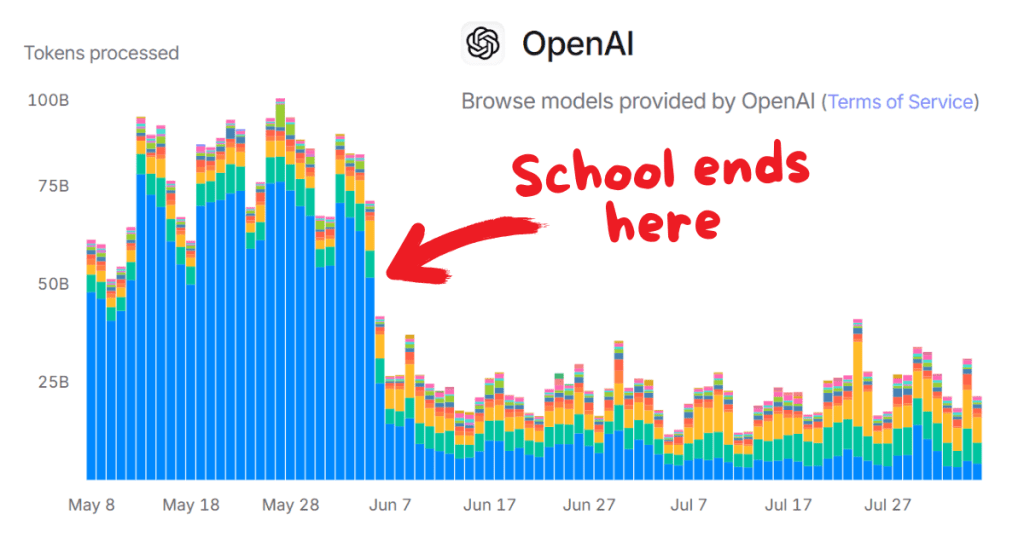
Photo Credit: Cheezburger
Statistics prove that even if not all students admit to cheating, a strong majority do. AI usage rates plummet upwards of 70 percent the second students are free of assignments for the summer.
Another major concern people have is that doctors and lawyers can cheat their way through schooling and important tests. No one wants a doctor looking up how to remove a tumor as they are about to go under.
It’s ironic because, in some cases, students generate their articles and then the teachers grade them with AI. At that point, why are we even going to school anymore? Maybe that’s it. Will school even be needed if all the world’s information is at our fingertips?
A less extreme view of this idea is that school can be adapted to fit the world of artificial intelligence. Schools could focus more on critical thinking and understanding different viewpoints from people around the world, instead of memorizing math problems and historical facts.
This could make school a more enjoyable place to be. Students could focus more on their interests and learning about themselves. To go even further, will AI go as far as to take teachers’ jobs entirely?
Carnegie Learning’s MATHia has already begun to simulate the role of a real teacher. MATHia is a website where students solve math problems like in MathXL. However, MATHia distinguishes itself from other math sites by not only providing right and wrong answers. It can study how students perceive each unit. By doing this, students’ lesson plans contain more personalized problems and receive more targeted feedback.
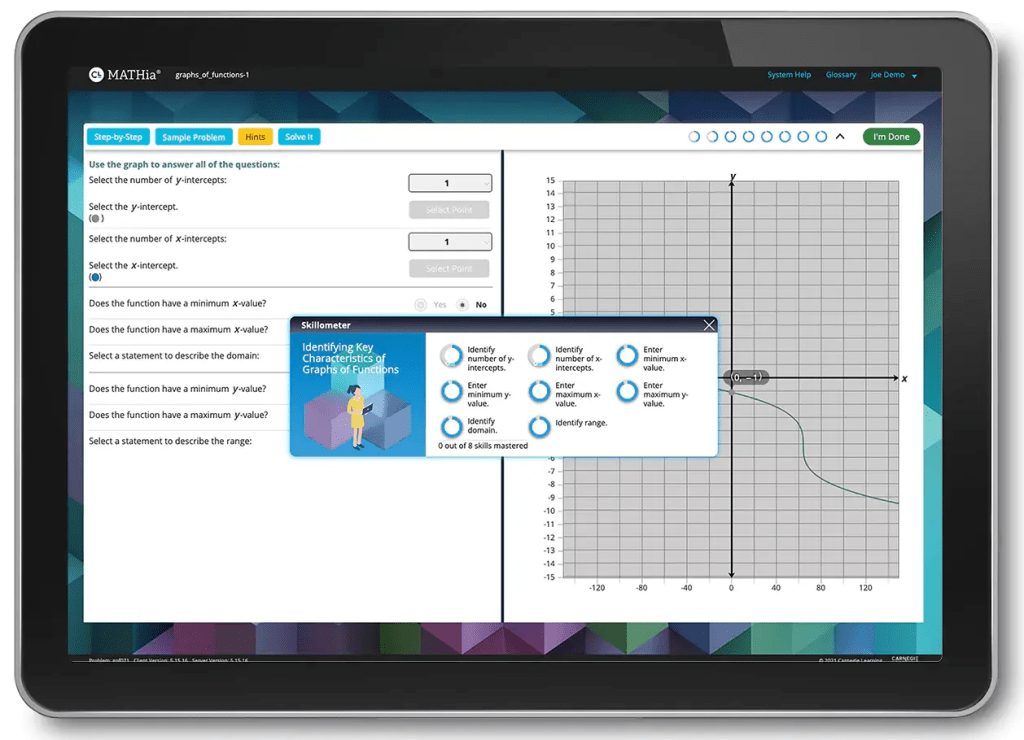
Photo Credit: Carnegie Learning
While this program is very advanced, it is not ready to take the jobs of teachers. A real person will always be necessary. Students need personal connections with teachers. Interacting with other people is an essential part of going to school.
AI will never be able to create genuine human relationships, no matter how advanced it may get. While many people might not prioritize it, human connections are a very vital thing that one will gain from going to school.
ChatGPT is changing the landscape of schooling at a rapid rate. Whether it will help or hurt the education system is uncertain, but one thing is for sure: it is here to stay. Students in the next few decades will have to decide whether they’re going to use this ground-breaking tool to enhance their learning or to escape it.
Featured Image Photo Credit: Adobe Stock
 The Paper Wolf