

UFC fighters are the world’s most dangerous athletes participating in the world’s most dangerous sport, risking brain injury, broken bones, and a career-ending layoff with every bout.
But you’d never guess this off their meager paychecks.
The Ultimate Fighting Championship (UFC) denies fighters basic worker rights, such as health insurance, a retirement plan, and even collective bargaining. The UFC sells glory, but rarely pays for it.
Most athletes join the organization via an entry-level contract, which only means they will earn $12,000 to show and $12,000 to win. Fighters have to pay for their own training camps, which on average is 6 weeks and costs around $15,000; they also have to cover all medical expenses, which are common in the world of fighting.
UFC fighters only fight 2-3 times a year, which means someone who has just entered the most prestigious world of competitive fighting is only making around $40,000 a year, if they don’t lose. If UFC is by far one of the most dangerous sports on earth, then why do only the very top earners reap million-dollar rewards?
When the cheering stops and the Octagon door closes, the reality sets in: that hero, the star of a multi-billion dollar global entertainment enterprise, will take home less in a year than a rookie in Major League Baseball makes in a week.
For every $1 million the UFC earns, the UFC on average pays out $180,000 to its athletes. The National Football League (NFL) pays its athletes $488,000 for every $1,000,000 made, a steep contrast compared to the UFC. Saint Paul’s senior Connor White thinks that this huge difference is an issue.
“UFC fighters risk way more inside the game than any other professional athlete, so I think they should be some of the biggest earners, but that just is not the case. Even when you think about the skill and athleticism in the UFC compared to other sports, I think of it as the highest level,” White said.

Photo Credit: bloodyelbow.com
A significant aspect of mixed martial arts (MMA) revenue is the pay-per-view (PPV) model, which plays a crucial role in fighter compensation. PPV events aren’t ordinary fight nights; they are highly anticipated bouts and championship title shots. Some fighters see this as their financial break, but the reality is harsh.
The biggest PPV of all time was UFC 229, Conor McGregor vs. Khabib Nurmagomedov, which sold an astounding 2.4 million PPV purchases. Despite the event’s massive success, McGregor reportedly received approximately $25 million from the PPV revenue, equating to about 6.7% of the total earnings. McGregor is widely regarded as the biggest star that the MMA world has ever seen, yet he still only gets a fraction of the UFC’s fortune.
One of the main contributions to the lack of UFC fighter pay is the absence of a fighters’ association. Unlike other popular professional sports leagues, such as the NFL or Major League Baseball, the UFC has no players’ union to negotiate better pay or benefits of any kind on behalf of the fighters.
“The worst part about (being a fighter) is not being paid what we’re owed and what we deserve — and not having a union to back us up,” one surveyed fighter under contract to the Professional Fighting League (PFL) said.
Without the ability to collectively bargain, the fighters have no choice but to accept whatever terms the UFC offers. Contracts are extremely restrictive; they completely limit the athlete’s ability to showcase their sponsors, which consequently leads to a lack of attention from outside sources. Before the uniform deals, fighters could promote their camps and personal sponsors on their shorts and post-fight outfits, turning each fight into both a competition and a vital source of income.
This was a huge source of funds for any fighter who could get their hands on a sponsorship deal. But when the UFC signed an exclusive contract with Reebok (and later with Venum) in 2014, those opportunities vanished. For many, that change meant losing more than they gained in fight winnings.
Legendary level fighters like Anderson Silva and Demetrious Johnson had huge brand deals that were effectively part of their images as athletes. Demitirous Johnson Represented X-Box, which not only brought him income but also showcased his passion for fans and gamers alike. Anderson Silva, on the other hand, had a deal with Burger King, another big-name brand that was eager to showcase itself on a high-level fighter. The UFC didn’t just cut another source of income for fighters; they also cut a way for fighters to express themselves physically.
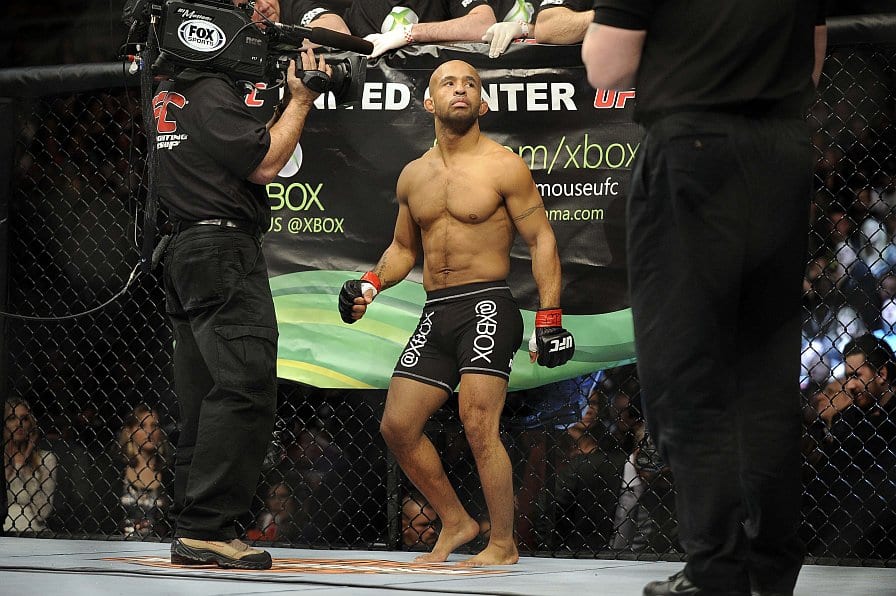
Photo Credit: lowkickmma.com
Although it may seem like UFC fighters are getting the star treatment they deserve inside the octagon, as soon as their fight ends, they are faced with the reality of the UFC’s treatment. In the preliminary fights that lead up to the main card, fighters are almost instantly kicked out of the arena as soon as their fight ends.

Photo Credit: John_Kavanagh/X
UFC bantamweight contender Payton Talbott reveals that post-fight, after doing media, he was escorted out of the arena and wasn’t allowed back in. He says they asked him if he had a ticket, to which he replied, “I just fought.”
But he is one of the many fighters who have to go through this experience. UFC-ranked light heavyweight Johnny Walker was kicked out after his win at UFC 279 against Ion Cutelaba. He wasn’t allowed to shower, speak with the media, or even change out of his fight gear before being thrown out onto the streets.
Fighters who choose to speak out against unfair pay take the risk of being cut or blacklisted, which creates a sense of fear and silence throughout the community of UFC fighters. Former champion and UFC star Francis Ngannou left the UFC in early 2023 after a public pay dispute. Francis argued that he should have total freedom over his sponsorships; he estimated that he left over 7 million on the table, because no deals proposed to him met the freedom he wanted. Francis reasoned that fighters should have health insurance, a contractual structure that allowed true independence, and the ability to participate in boxing events.
Saint Paul’s senior Aidan McLain is sad to see the dispute between Francis Ngannou and the UFC. “Francis Ngannou was one of my favorite fighters because he was so entertaining, but honestly, I don’t blame him for standing up and fighting for his freedom. I’m mad that he has to go, but someone had to say something,” McLain said.

Photo Credit: Justin Setterfield/Getty Images
Once his deal expired, he was stripped of his heavyweight belt, and the president of the UFC, Dana White, claimed that he would never come back, which has stayed true till this day. Francis was recorded saying, “In that contract, I’m not free… I hand over all the power to you guys, and I’ve seen in the past how you can utilise that power.”
Francis Ngannou’s departure from the UFC was not just a financial move; it was also a matter of control, respect, and protection. Those are things that very few fighters receive. For most of them, the battle never ceases when the referee steps in; it continues way beyond that, in terms of constant injuries, surgeries, and concealed pains.
BJ Penn’s story illustrates this darker truth. A UFC Hall of Famer and one of the sport’s most decorated fighters, Penn’s post-career has been marked by signs suggesting the long-term impact of continued blows to the brain. While CTE (chronic traumatic encephalopathy) itself cannot be diagnosed until after death, Penn’s behavior and symptoms are consistent with the average symptoms of CTE.

Photo Credit: Jeff Chiu/AP
In 2025, Penn declared that he had developed Parkinson’s disease, a neurodegenerative disease sharing symptoms with CTE, including tremors, memory loss, and mood changes. His revelation came after erratic public statements, conspiracy theories, and claims that CTE is a fabricated diagnosis.
Further complicating matters, Penn’s family has expressed concern over his mental health. His mother filed a restraining order against him, citing erratic behavior and delusional thinking, such as believing his family had been replaced by impostors.
The issue with this tragedy isn’t that he has signs of CTE, but that the UFC has done nothing to aid him or his family, and this conflict isn’t exclusive to just BJ Penn. Other fighters, such as Ben Askren, who suffered a collapsed lung and was put in critical condition, were never helped at all by the UFC. The UFC disguises this scandal by identifying fighters as “independent contractors” instead of treating them as members of the organization.
Former Lightweight champion Charles Olivera is an icon of the sport. He has the most finishes in UFC history at 21, the most submissions in the organization’s history at 17, and the most bonuses at 21. Yet while still being such an accomplished fighter, Olivera still does not live up to the wealth he might be perceived to have.
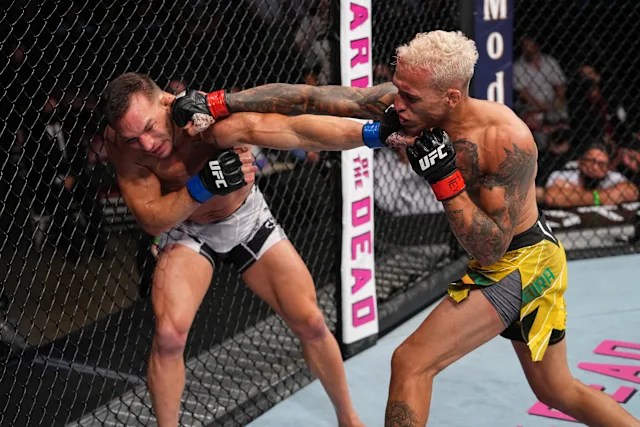
Photo Credit: Josh Hedges/Zuffa LLC
After winning the Lightweight belt in 2021, Olivera was asked about his current wealth and financial issues within the UFC. “I have to pay for training, supplementation, it’s complicated,” Oliveira told mmamania.com.
“People think I’m rich, but I’m not. I’m still going to become rich, I’m going to make money with a percentage of pay-per-view, I’ve reached a level where I start to make serious money. Things will start to improve, more than they already are.
“Do you know how much gets deducted?” he continued. “The team alone gets 30 percent, then you need to discount another 12 or 15 percent depending on which U.S. state you fought in. You have other deductions for I don’t know what or to where. When you see it at the end you got less than guys who didn’t do anything. I didn’t earn $50,000 bonuses 17 times. I actually earned $15,000, $12,000, $10,000.”
The very concept of the Ultimate Fighting Championship was born from a pure, gladiatorial ideal: to pit the best martial artists in the world against one another in a true test of combat. It was meant to be a proving ground where skill, discipline, and heart would reign supreme.
The global empire the UFC has since built rests entirely upon the talent and profound risk taken by these athletes, who deserve compensation that reflects the billions in revenue they generate.
Instead, the UFC has abandoned this sporting integrity, denying fighters what they truly deserve, competing in the greatest fighting stage the world has to offer.
Featured Image Photo Credit: AP Photo/Ella Hall
 The Paper Wolf