
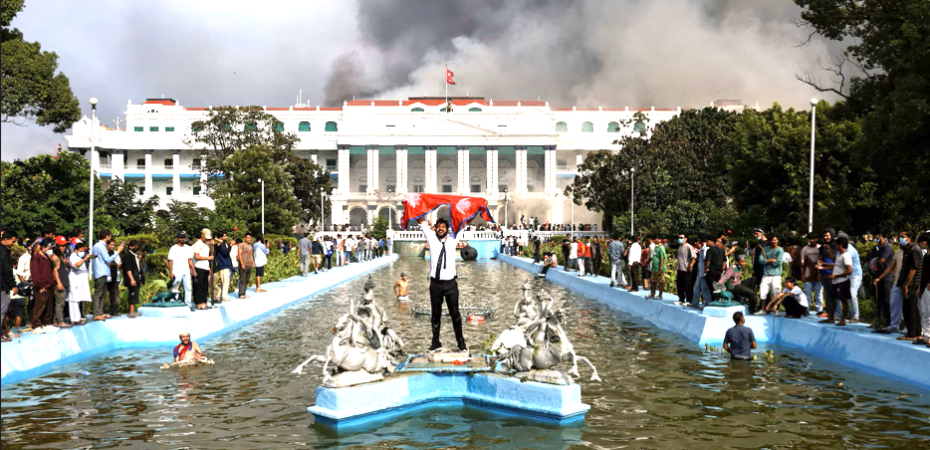
The Government of Nepal collapsed after Gen-Z protesters revolted, burned down the Federal Parliament, and forced Prime Minister K.P. Sharma Oli to resign on Sept. 9, 2025.
The revolution was caused by the violent killing of 72 protesters, and the government’s decision to ban almost every social media app.
The protests led to Kathmandu, Nepal’s capital, being consumed by fire. Government buildings, such as the Supreme Court, the Federal Parliament Building, and the Singha Durbar (the center of the Nepali government, containing the Prime Minister’s office), were set on fire or at least vandalized. Even the Prime Minister’s own home was not safe from the movement’s fire, as protesters broke into the property, vandalized it, and set it on fire.
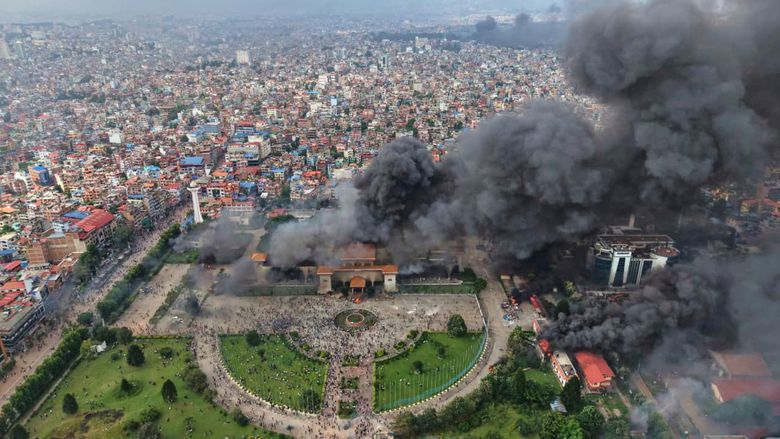
Photo Credit: Prakash Timalsina
The protests started off peacefully, but they eventually became violent when police started using water cannons, tear gas, and even live rounds against crowds of protesters. This led to the deaths of 72 people and 2,113 people being injured, many of whom were young students.
The protests initially started because of the Government of Nepal’s decision to ban over 24 social media apps, such as Facebook, YouTube, Snapchat, Discord, and Instagram. The government announced the ban on Sept. 4, 2025, and justified it by claiming that the platforms had failed to comply with the new regulation rules, which required them to have a local contact and to cooperate with law enforcement.
However, many people saw the ban as an attempt to censor and suppress the online campaign #NepoKids, which showed off the lives of rich politicians’ children, while many people were struggling just to get food on the table.
The social media ban was the last straw, as it removed the last platform that people could use to safely speak out against the Nepalese government’s corruption.
The activists found a symbol for their movement from the popular Japanese anime and manga, One Piece, the Jolly Roger flag of the Straw Hat Pirates. In One Piece, The Straw Hat Pirates, led by their Captain, Monkey D. Luffy, are outlaws who fight against the corrupt “World Government,” which controls the world with an iron fist.
The flag (a skull wearing a straw hat) represents liberation, freedom, and defiance against the corrupt government. “By using the flag during the burning of Nepal’s government buildings, the protesters mirrored the Straw Hat Pirates’ attempts to resist the corrupt World Government,” Saint Paul’s senior Edward Pope said.
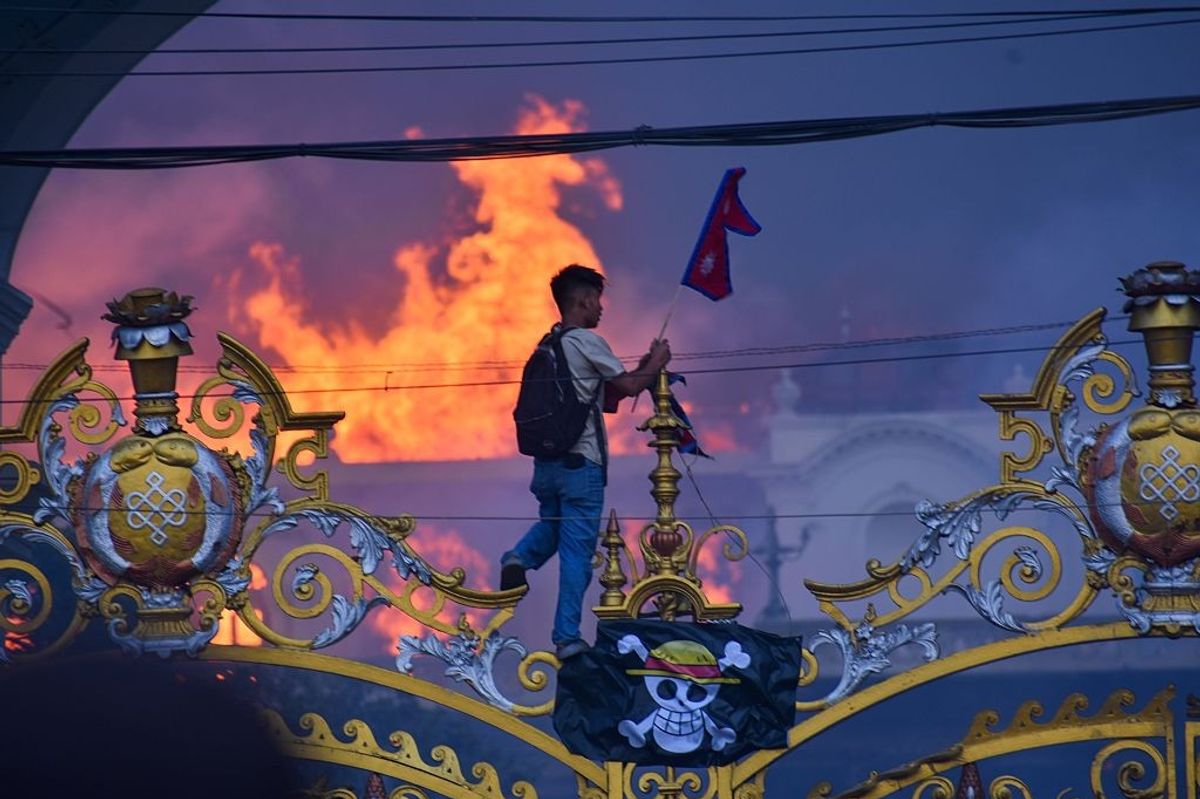
Photo Credit: Sunil Pradhan/Anadolu via Getty Images
Police brutality in the protests caused protesters to shift their attention from an issue of media rights to an issue of corruption and violence.
Decades of systemic corruption and economic problems that have been plaguing the people of Nepal have only served to fuel the protesters’ fire.
For years, Nepal had suffered from systemic corruption, where politicians’ blatant lies were not only frequent but something that was fundamentally built into its political system. The corruption within Nepal’s government allowed for political patronage to thrive, a system where a political leader gives jobs and government contracts to people who are loyal to their party, instead of people who were more deserving candidates.
This corruption had serious consequences beyond the government, as it also severely impacted the economy. Even before the revolt, Nepal’s economy was extremely flawed. Nepal’s youth unemployment rate was over 20%, which is insanely high compared to many developed countries, per Macrotrends.net, demonstrating that Nepal has struggled to provide sustainable jobs for its people.

As a result of the lack of opportunity in Nepal, many people had to start accepting jobs abroad to be able to support their families. Because of the large number of people working abroad, remittances (receiving/sending money abroad, often to support family or friends) accounted for nearly a third of Nepal’s GDP (theglobaleconomy.com).
The fact that Nepal’s economy was so dependent on money from foreign work showed the people of Nepal how fragile their economy was and that their government had failed to create opportunities for them.
After the government’s collapse, a huge power vacuum was created that needed to be filled before the country fell into chaos.
Moreover, Nepal needed to find a new way to elect an interim Prime Minister.
Now, Gen-Z activists, who have been using a server on the social media app Discord to plan protests and figure out their goals, are using the app to plan future political plans.
Discord was one of the apps that was banned by the government; however, many activists used programs called VPNs (virtual private networks) to get around the government’s ban. Since using Discord was already the group’s way to plan protests, it was decided that it would be used to host an online vote to name an interim Prime Minister. The server, which held over 100,000 members, held long debates – that included polls – to decide between candidates.
“Honestly, I think it’s crazy that Discord, an app that lets me and my friends talk to each other while we play games, was used to elect a world leader. I feel like this shows how much power the youth really has. They were able to elect a world leader in a way that has never happened, just days after they overthrew their corrupt government. I find the whole thing inspiring,” Saint Paul’s senior Evan Vanderbrook said.

Photo Credit: adxtya_jha/ X
On Sept. 12, 2025, the online vote led to the appointment of former Chief Justice Sushila Karki.
She has now become the first woman in history to lead Nepal’s government. Known for being tough on corruption, she had put a minister in jail years before for corruption, which definitely appealed to the Gen-Z activists.
Now that Karki is the interim Prime Minister, her job is to restore political stability and fulfill the protesters’ demands. Though her top priority is making sure that the upcoming March 2026 elections are free and fair, other objectives include rebuilding Nepal’s economy and creating stronger anti-corruption laws, so that the same mistakes won’t be repeated.
Since her election, the Government of Nepal has begun investigating the deaths and destruction that resulted from the uprising.
The cost of the uprising was massive, with the total damages estimated to be worth upward of 3 trillion Nepalese rupees, or $21 billion, which is nearly half of Nepal’s GDP.
The large-scale damage to many of Nepal’s key public buildings and private businesses threatens to stop economic growth entirely. Presently, Karki’s biggest challenge is to make people trust the economy, despite all of the damage.
Whether this movement actually brings lasting change or simply fades into history, one thing is clear: Nepal’s future is in the hands of the next generation.
Featured Image Photo Credit: Navesh Chitrakar/Reuters
 The Paper Wolf