

High school days need to start later.
High school students are suffering in many ways, in part due to early school start times. High schools should start later in the day to reduce the strain on students’ overall well-being.
There are only a handful of high school students who get an appropriate amount of sleep each night. In this regard, the lack of sleep many students experience can pose various risks and problems. One main reason for this loss of sleep is the early start time of school.
This is an issue because many teens struggle with waking up early due to a shift in their circadian rhythm; they naturally fall asleep and wake up later.
This is because melatonin is released later at night, making early sleep almost impossible, biologically; thus, asking a teen to wake up at 6 a.m. is like asking an adult to wake up at 4 a.m.
Occasionally, Saint Paul’s School has late start days, allowing the student body to get an extra hour of sleep. These are occasions many students look forward to, as they help them feel more rested before they start working.
Saint Paul’s sophomore Collin Sparrow finds late start days to be a great thing. “A lot of the time, I don’t get a great amount of sleep, so I’m usually tired throughout the day and before I go to the gym. Whenever we have late start days, I actually feel like I have more energy, and I’m more prepared,” stated Sparrow.
Conversely, some argue that later school start times would interfere with extracurricular activities. It makes sense: if school starts later, students would also have to leave school later. It’s possible that practice or club meetings won’t end until 5:30 p.m., rather than 4:30 p.m.
Another reason some criticize later school start times is that they can affect parental work or childcare. Parental work often revolves around working during school time; thus, if school were to start later, it could interfere with a parent’s occupation.
These points, however, are not always the case.
For instance, many studies, such as a 2022 Minnesota case, have found a minimal impact on participation, parental work, or childcare.
More importantly, it is better to focus on the health and academic benefits of attending an extracurricular activity than on missing or being late to it, as it offers far more benefits. These benefits can include decreased car crashes, less risky activity, improved physical and mental health, better grades, and increased attendance and participation.
Studies have even shown that later school starts have actually improved extracurricular activity performance. However, this is just the beginning of the pros of later school start times.
Car accidents are a major problem in the U.S. currently.
According to iihs.org, these accidents are a leading cause of death among citizens between the ages of five and 29. In 2023, there were over 40,901 motor vehicle deaths, or 112 deaths per day. Furthermore, beyond fatalities, car accidents in 2022 caused over 2.6 million casualties.
However, many studies have shown that later school start times have reduced the risk of car crashes in adolescent drivers.
According to sleepjunkie.com, drowsiness caused by lack of sleep causes one in 10 car accidents every year, and 27% of these driving accidents involve teenagers. Students with later school start times are involved in significantly fewer car accidents.
In addition, high school students with later start times are less prone to engage in risky, harmful behaviors.
For example, nhlbi.nih.gov found that students who get under eight hours of sleep were twice as likely to use drugs, alcohol, DUI, carry weapons, or get into fights. If school started later, many students would be half as likely to perform these crimes against themselves.
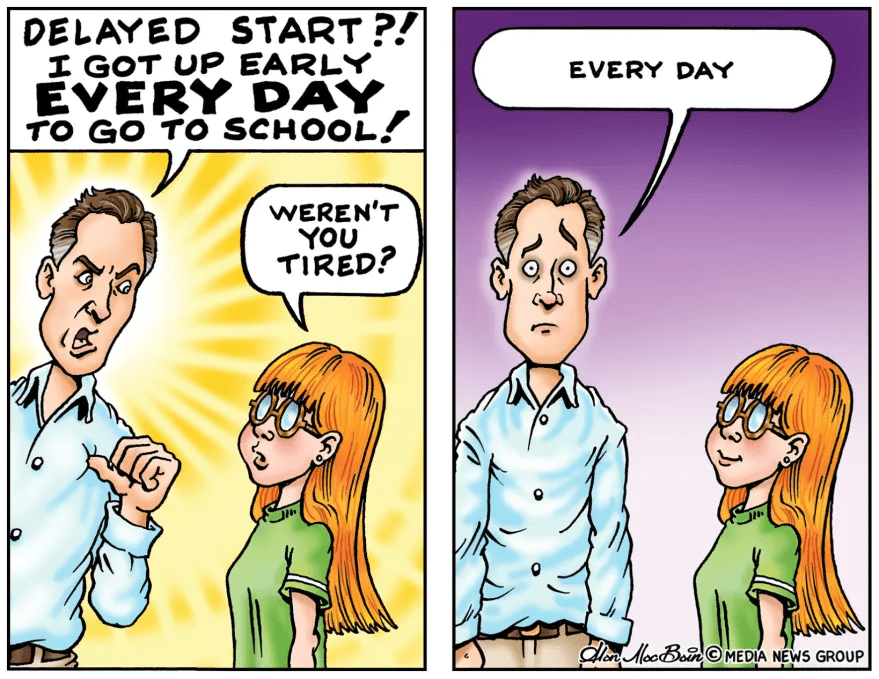
Physical and mental health would also improve with later school start times. Less sleep can lead to mood swings, loss of attention, and irritability. Less sleep can also lead to diabetes, high blood pressure, and obesity. These effects are even worse when teenagers rely on high amounts of caffeine every day.
Furthermore, mountainheightsacademy.org states that insufficient sleep can stunt physical growth because, during deep sleep, teenagers produce growth hormones for their bones and muscles. Obviously, enough can’t be produced if students aren’t getting enough sleep.
High school students need adequate sleep to support their health, proper growth, and strength and energy for other activities, such as sports and even jobs.
Saint Paul’s junior Julian Conzonere advocates for a later school start. “Getting more sleep would support my performance. I feel that it would also just boost me, generally, for the whole week too,” stated Conzonere.
Clearly, students should try to go to bed earlier to help decrease some of the negative effects, but it’s also not disputable that studies of schools that implemented later start times have found that it actually increases student attendance and academic performance.
Many schools have tried implementing later start times, each of them finding that test scores, other grades, and attendance improved; sickness and even stress levels were found to have decreased. For instance, a study held in Seattle found that, after a later start, students in a biology course had a 4.5% increase in final grades.
In addition, late school starts aren’t just favored by students; many teachers think they’re beneficial as well.
Saint Paul’s religion and Spanish teacher, Mr. Barrett Baumgartner, is one of these wise men. “According to my understanding, teenagers benefit from later start times, as they allow for more sleep. I think it would benefit students greatly,” stated Mr. Baumgartner.

By the same token, later school start times can even improve the U.S. economy.
A study by Rand.org found that starting school at 8:30 a.m. or later could grant significant benefits to the United States’ economy. RAND’s study concluded that delayed school start times could save the U.S. $83 billion by reducing car crashes and improving academic achievement.
Even large health organizations advocate for this decision.
The American Academy of Pediatrics is one of these organizations. Publications.aap.org recommends that middle and high schools start no earlier than 8:30 a.m.
Likewise, many countries with highly achieving academics start their school days later than the United States. The United Kingdom starts from 8:45-9:00 a.m., Finnish schools can start as late as 9:00 a.m., and Italy starts at 8:30 a.m. This is clear proof that school days can function perfectly well —and even better — with later start times.
The change does not have to be drastic.
High schools should start at 8:30 a.m. and release at 3:30 p.m.
These times are neither too early nor too late. Moreover, starting at 8:30 a.m. has been found to yield significant improvements, and ending at 3:30 ensures that students still get the required time in school without ending the day too late if they participate in extracurricular activities. Moreover, many parents would find this proposal aligns better with a 9 a.m. – 4 or 5 p.m. workday.
High schools should start later in the morning. It isn’t a time management issue or a matter of blaming students for not getting enough sleep; it’s an issue of improving society as a whole.
Photo Credit: covenanthealth.com
 The Paper Wolf