
The NCAA opened the transfer portal in 2018, which rocked the college football world. Fans, players, coaches, and analysts all have a variety of opinions on one of the most consequential rule changes in NCAA football history.
The portal opens after the end of every college football season for 30 days. This season, for example, the transfer portal opened on December 3, 2023, and closed on January 2, 2024. During this time, athletes must notify their school that they intend to transfer. Next, a 48-hour window opens for the school’s compliance department to put the athlete’s name in the portal.
As long as the athletes are put in the portal during the 30-day timeframe, they can decide at any time on the next school they want to attend, even after the window closes; however, they must fit the enrollment criteria.
If an athlete wishes to change schools and does not enter the portal during the 30 days, they will not be eligible for a year due to the NCAA’s one-time transfer rule.
The transfer portal is highly controversial because there is an abundance of athletes trying to transfer, and it’s changing the college football landscape. As a result, this has sparked a massive debate among college football fans on whether the portal helps or hurts college football.
Two Saint Paul’s students have opposing views on the impacts of the transfer portal, and both present their arguments below.
Saint Paul’s Junior Callahan Leahy: The Transfer Portal HELPS College Football.
The transfer portal is great for college football because it has allowed athletes to get out of bad situations that they used to be forced to stay in. The portal also makes the transfer process less complicated than it used to be.
Before the transfer portal, student-athletes had to ask their coach for permission to contact other schools. If denied, student-athletes could ask the athletic director. If permission was still denied, student-athletes could ask a campus administrator. If their request is still denied, the final resort would be to appeal to a committee of professionals on campus.
Without permission from anyone on campus, student-athletes couldn’t receive athletics aid at the school they transferred to. This wasn’t fair because even the best players in college football would not get paid simply because people on campus wanted them to stay.
Even if athletes felt mistreated by their coaches or were unhappy with the program, they were forced to stay if they didn’t want to pay for college. In sum, without the portal, coaches had bigger opportunities to ruin their players’ time and not allow them to leave.
The transfer portal, however, forces coaches to treat their players better and develop good relationships with them if they don’t want them to transfer.
For instance, Kentucky football head coach Mark Stoops maximizes his players’ experiences and strengthens his relationships with them because he knows his players are likelier to stay. ”This is a relationship business. As busy as we are, as much as we all have to do, spending time with the players, investing in the players, having the players at your house, having them in for meetings. Keeping that contact is, in my opinion, one of the most important things.”
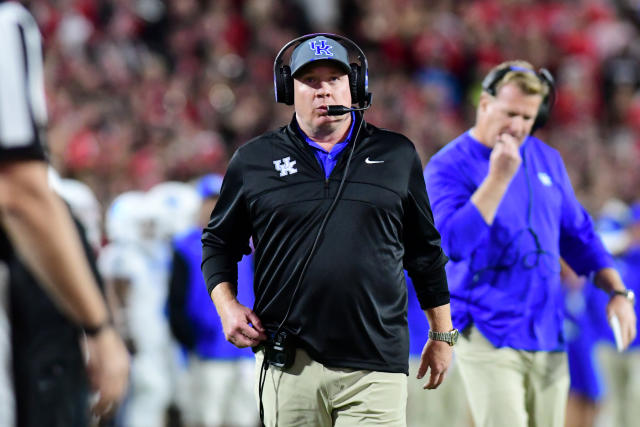
Photo Credit: Perry McIntyre/ISI Photos/Getty Images
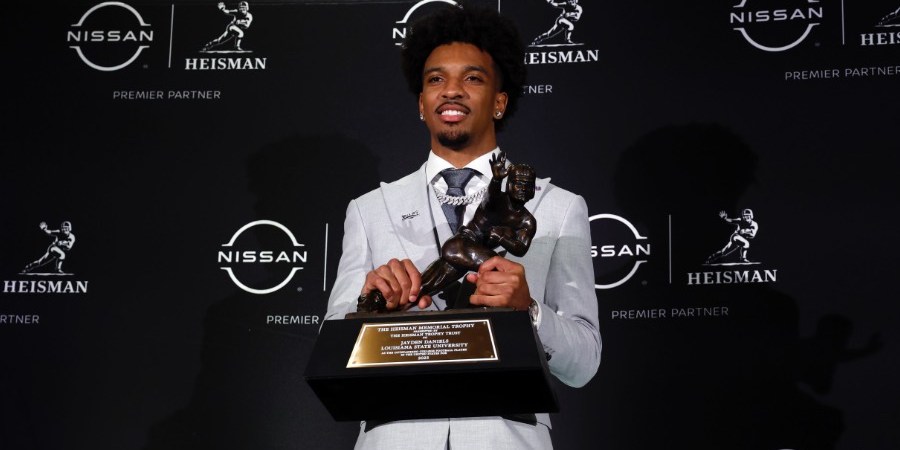
The portal has also allowed some athletes to prove themselves, which they otherwise wouldn’t have if they didn’t transfer schools. Heisman Trophy-winning quarterbacks Jayden Daniels and Caleb Williams are both transfers who proved themselves in better situations; now, both quarterbacks are likely to be selected within the top five picks of the 2024 NFL Draft.
Daniels spent his first three years at ASU until transferring to LSU for his last two years. In Daniels’ final year at ASU, he only threw for 2,380 and 10 touchdowns, while throwing 10 interceptions. Fast forward to his last year at LSU, where Daniels threw for 3,812 yards and 40 touchdowns with only 4 interceptions in his Heisman campaign. LSU brought out the potential that Daniels could not unlock at ASU.
”For my career, my future, I decided to go somewhere else just so I can reach into that untapped potential,” Daniels explained.
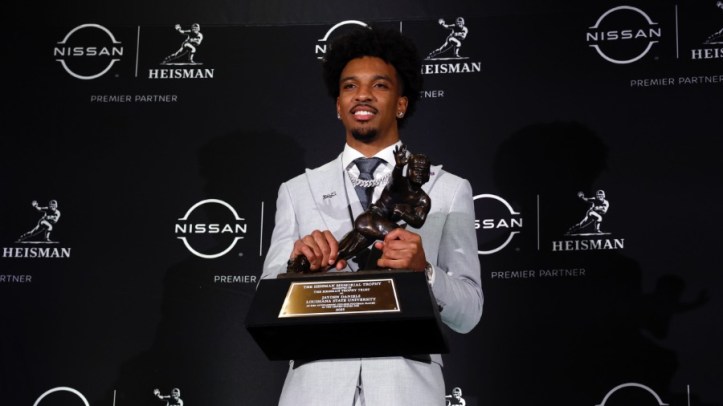
Photo Credit: Sarah Stier/Getty Images
Moreover, the transfer portal shakes up the competition in college football and diminishes dynasties.
Football fans have criticized college football for having the same teams at the top every year. Some teams that weren’t in contention before the transfer portal have risen to the top, such as the Texas Longhorns, which clinched a College Football Playoff spot for the first time ever, and the Washington Huskies, which recently made its first National Championship appearance. Both teams owe their outstanding success to the transfer portal.
Through the transfer portal, the Huskies acquired running back Dillon Johnson, who rushed for 1,195 yards and 16 touchdowns, and cornerback Jabbar Muhammad, who caught 3 interceptions, deflected 14 passes, and recorded 41 tackles last season. Similarly, the Longhorns acquired quarterback Quinn Ewers, who threw for 3,479 yards and 22 touchdowns, and wide receiver Adonai Mitchell, who had 845 receiving yards and 11 touchdowns last season. These transfer portal players were crucial to the Huskies’ and Longhorns’ historic seasons.
Photo Credit: ESPN
Overall, the transfer portal gives players new opportunities and makes the transfer process easier. The flexibility is a great thing for the players, and the player movement among teams makes college football more interesting.
Saint Paul’s Junior Andrew James: The Transfer Portal HURTS College Football.
Initially, athletes were only granted one transfer over their collegiate career without punishment. Players were allowed to transfer more than once; however, each transfer from that point on would cause them to sit out the following year. However, according to AP News, as of December 13, 2023, a federal judge changed that rule, and now they are granted two transfers without receiving any penalty.
The NCAA allowing these changes is proof that the association is becoming softer by the minute, which is harming the game we all love.
Players shouldn’t be given a chance after chance to get on a perennial powerhouse like Alabama. If they go to a school, that is where they need to stay for all four years, no matter the circumstances.
Adding on to this point, college athletes–who, 10 to 15 years ago, were making no money–are now only loyal to their NIL deals. NIL stands for Name Image and Likeness, which allows collegiate athletes to have sponsorships and get paid.
This may seem like a separate issue, but NIL and the transfer portal tie in together very well. Most players nowadays will attend the school that gets them the most recognition; thus, a larger influx of money from NIL deals. With the increased use of the transfer portal, players from small schools now have the opportunity to go to a bigger school where they can play in nationally televised games, which will result in more recognition and money.

Photo Credit: USA TODAY Sports
For example, former Louisiana Tech Bulldog Tre Harris III was not widely known as a great receiver until he joined the Ole Miss Rebels before the 2023 season. Although he put up nearly identical stats between his junior year at Louisiana Tech and senior year at Ole Miss, his NIL deals went through the roof, bringing him to an estimated $492,000. Why? Because he switched from an average Conference USA team to a top-tier SEC team.
Although Harris III’s move to Ole Miss helped him get more recognition, which will improve his draft stock, it’s further proof that the NCAA is becoming all about the money and less about the game itself.
While the portal is a bad aspect of the game and needs to be removed, that doesn’t mean there isn’t some good that has come from it. For fans, it is good because their favorite teams can go from the bottom of their division to the top in just a couple of years.
For instance, the Washington Huskies offense has been built by the transfer portal. With star players like quarterback Michael Penix Jr, running back Dillon Johnson, and receiver Ja’Lynn Polk coming to the team over two seasons, this year was their year to make a run in the playoff. They did just that, going from a 4-8 record in the 2021-22 season to a National Championship game appearance this past season. What would’ve been a nearly impossible feat ten years ago was now made possible by the transfer portal.
Saint Paul’s junior Vincent Cruise weighed in on the effects of the portal: “The transfer portal is a key piece of the college football landscape today. It may be overused, and there might need to be some changes made, but the reality is that it helps teams fill holes in their roster, and it can give players better opportunities to shine at bigger schools.”
While Cruise made a valid point, players usually have better chances to succeed at smaller schools where they won’t be fighting for a roster spot. Of course, many great players are abnormalities to that point, but this is directed toward the players who won’t be given a chance at more prominent schools. It should be common knowledge for the players to keep dominating at a small school rather than fight for a third-string spot on a powerhouse.
The portal can also affect those other than players, like coaches. The mentality that players have now, constantly trying to switch schools, is starting to pose recruiting challenges. Only a few years back, there was no concern with players committing early because, most of the time, the players were loyal to their school.
Now, programs can never be too sure about their early recruits, as they’re constantly flipping their commitment just before their freshman season. For example, high school senior quarterback Dylan Raiola committed to Ohio State in May 2022, then flipped his commitment to Georgia in May 2023. Finally, he pledged to commit to Nebraska just about a month ago. This marks his third commitment before he has even begun his college career.

Photo Credit: Hayes Fawcett/X
Following legendary Head Coach Nick Saban’s retirement, Alabama has already lost a staggering 27 players to the portal.
This stat shows how many players solely went to Alabama to play under the greatest coach of all time. But, one can’t look past how they couldn’t care less about the school, as they were just in it for the coach.
Additionally, after former Washington Head Coach Kalen DeBoer left to replace Saban at Alabama, the Huskies lost a significant transfer in quarterback Will Rogers. He left less than an hour after DeBoer announced he was leaving. Rogers led the all-time Mississippi State passing yards and touchdown records. He then transferred to the Huskies, where he was on the team for less than a month before re-entering his name into the portal.
According to On3’s Pete Nakos, 29.7% of the top 100 recruits over the 2021, 2022, and 2023 seasons have transferred at least once in their career. This is a devastating blow to college football, as the portal has only been around for a few years. With that being said, who knows what these numbers will be 5-10 years down the line?
Overall, due to the transfer portal, college football is a money league now, and it’s taking all the integrity out of the game.
 The Paper Wolf