
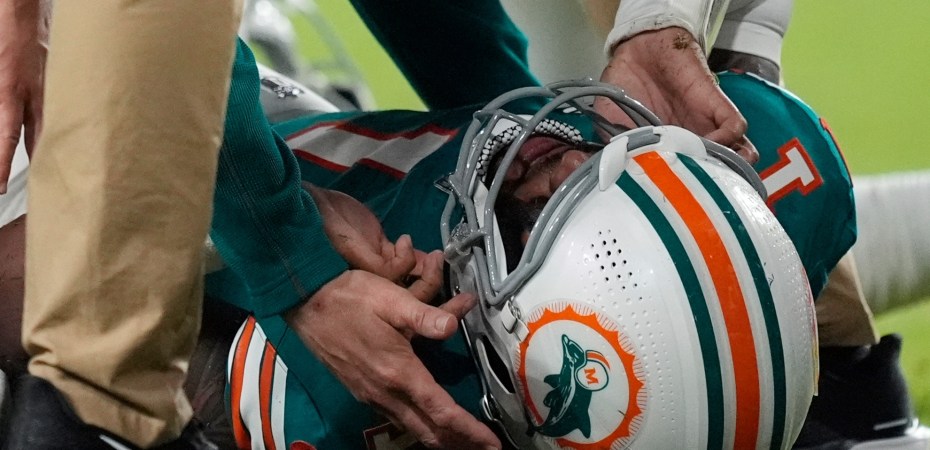
The majority of football players at every level are silently suffering from one of the sport’s most dangerous conditions, Chronic Traumatic Encephalopathy (CTE), yet no one seems to care.
CTE is a brain condition thought to be linked to repeated head injuries and blows to the head. It slowly gets worse over time and can lead to conditions like ALS, dementia, and Parkinson’s disease. According to the National Health Institute, symptoms of CTE are behavior changes/mood swings, short-term memory loss, problems with movement, and confusion, such as getting lost or not knowing what time of day it is. CTE’s worst impact, however, is death.
What’s possibly even more alarming than the known effects of CTE is that many researchers believe we are just scratching the surface of the prevalence of the disease. “The science surrounding CTE is merely in its infancy, which should scare football players,” said Saint Paul’s teacher Nicholas Guarisco. Guarisco has a Sports Law Certificate from Tulane Law School and has been tracking the impact of CTE among NFL athletes for the last decade.


Many current football players also may be diagnosed with CTE soon enough. One headliner is Miami Dolphins star quarterback Tua Tagovailoa. Tagovailoa was diagnosed with his third documented concussion in three seasons on Sept. 14, 2024, and many fear that this collection of traumatic brain injuries will result in long-term health problems such as CTE.
Tagovailoa’s history of traumatic brain injuries dates back to the 2022 season when he endured two concussions only a week apart from each other. The first injury, in week 3 versus the Buffalo Bills, was swept under the rug by the Miami Dolphins medical staff, and many believe the team violated the NFL’s concussion protocol.
In fact, the team’s failure to take seemingly obvious precautionary measures on a national stage forced the NFL to modify its concussion protocol.
:max_bytes(150000):strip_icc()/VWH-ZoeHansen-FencingResponse-Standard-9141e8b5a07c4521b584b069d3c6cc6a.jpg)
The second injury in week 4 against the Cincinnati Bengals was highly alarming. After taking a sack to Bengals nose tackle Josh Tupou, Tagovailoa had a “fencing response,” an involuntary physical position that occurs as a result of severe brain injury. It was reported later that this hit had left Tagovailoa unconscious. In addition, the hit sent him to the hospital. For these reasons, it was shocking to see Tagovailoa return to the field only two weeks after this string of injuries.
Yet another concussion occurred this year against the Buffalo Bills when Tagovailoa collided with Bills defensive back Damar Hamlin on a fourth-down run. After the impact, Tagovailoa was down for about two minutes but was fortunate enough to walk off the field. Tagovailoa returned six weeks after the initial impact.
Considering Tagovailoa’s injury history, many have urged him to medically retire from football or, at the very least, consider taking precautionary manners like wearing the guardian cap.
“Tua or players in his situation should highly consider retirement; while football is their passion, these players often have a family they must be there for. If these players who have [history with] traumatic brain injuries try to just play through it, then there is a chance they can harm themselves even further and shorten the time they’re able to spend with their families,” pleaded Saint Paul’s Junior Luca Rodas.
Tagovailoa has disregarded all of these wishes and concerns. In a press conference on Oct. 21, 2024, he shut down all conversations about him medically retiring or even wearing a guardian cap because of personal choice.
Now, many fans are severely concerned that he might worsen his condition and potentially lower his lifespan due to CTE.
One of the most severe cases of diagnosed CTE was found in former New England Patriots tight end Aaron Hernandez. Hernandez committed suicide in 2017 after being convicted for the murder of Odin Lloyd in 2013. After his death, researchers at Boston University revealed the 27-year-old Hernandez had stage 3 CTE, a condition never seen in someone younger than 46.
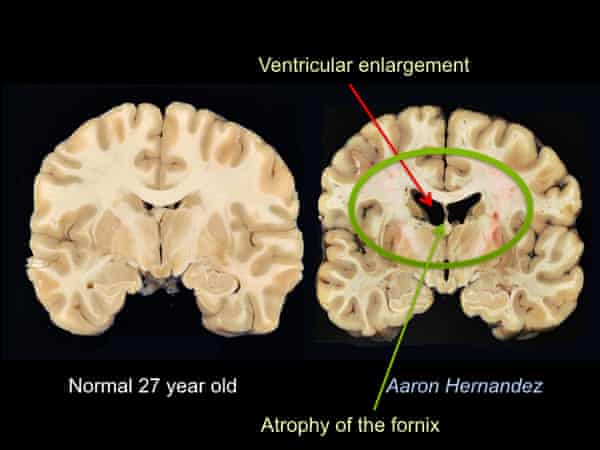
According to The Wasington Post, “Hernandez’s brain had dark spots associated with tau protein [a protein that helps stabilize the internal skeleton of nerve cells in the brain] and shrunken, withered areas, compared with immaculate white of the sample. His brain had significant damage to the frontal lobe, which impacts a person’s ability to make decisions and moderate behavior.”
Hernandez’s case is essential to studying CTE because the condition can only be studied postmortem. His alarming sample provided evidence that CTE does affect younger individuals. In fact, it can start to develop in children as soon as they are introduced to tackle football.
The odds of developing CTE may increase by 30% for each year of tackle football played, according to a 2019 Brain Bank study of 266 deceased football players published in Annals of Neurology. That means a high school football player who started at 5 years old instead of 14 might have ten times the odds of developing CTE, per the Concussion Foundation.
Accordingly, many Saint Paul’s football players are concerned about this, some quietly and some vocally. “Although hard hits are a part of football, I take the health of my brain very seriously, and I will always make it a priority to keep it safe. However, I am more concerned for my friends that have played football since a very young age and the impact it may have on their cognitive health in the future,” stated Saint Paul’s starting left guard Nathaniel Canizaro.
Hall of Fame quarterback Brett Favre is among many former NFL players who are notably against playing football at a youth level. “Having kids play [football] before high school is just not worth the risk. CTE is a terrible disease, and we need to do everything we can to prevent it for the next generation of football players,” said Favre. Favre reportedly was diagnosed with “three or four” in the NFL, but he estimates that he had about “a thousand” concussions throughout his lengthy football career. This discrepancy highlights one of the scariest aspects of concussions: the hidden reality is that players may sustain several – possibly hundreds – more concussions than they realize.
Another misconception about CTE is that it only affects a small number of players. That could not be further from the truth. In a 2023 study, Boston University’s CTE Center found that 345 out of 376 former NFL players studied had symptoms of CTE. That’s over 91%. In a similar study of a random group in 2018, Boston University found only one case of severe CTE out of 164 brains. The lone case was a former college football player.
Regardless of the varied results, why would anyone want to take the risk of developing this dangerous, preventable disease?
Predictably, one explanation is money. For many players, football is a way out of a challenging situation, a way to provide for themselves and their families. Despite the fact that only 1.6% of collegiate football players play in the pros, the marginal potential of making millions of dollars in the NFL entices these young players who may not fully grasp how dangerous CTE can be (or how slight their chances of making it to this level actually are). This view is accentuated by the rise of Name Image and Likeness (NIL) deals in college, and the seemingly growing amount of money stars make in the NFL.
The profit being made in the league is growing exponentially. This amount of money is almost impossible to ignore for anyone, especially someone who has struggled with poverty his entire life.
Still, football players – along with parents of youth football players – have to assess whether any amount of money is worth the potential impacts of CTE, including death.
 The Paper Wolf